Cloud Migration
Migrate from AWS, Azure, or GCP with Confidence
Switch to EU-sovereign OpenStack infrastructure without vendor lock-in. We guide you through every step, from assessment to cutover. Most customers see over 25% cost reduction while gaining true data sovereignty.
Why Migrate to Leafcloud
Lower Costs, True Sovereignty, No Lock-In
Hyperscaler bills spiraling out of control? Concerned about US CLOUD Act exposure in EU regions? Want infrastructure freedom with standard APIs? Leafcloud solves the problems that come with hyperscaler dependency.
Eliminate Egress Fees
Save €0.05-0.12/GB on data transfer. For data-intensive workloads, this can mean €1000s saved monthly.
True EU Data Sovereignty
Dutch-owned infrastructure in Amsterdam. Not subject to US CLOUD Act like AWS Frankfurt or Azure Netherlands.
No Vendor Lock-In
OpenStack standard APIs work across 40+ providers. Your Terraform and Ansible code is portable.
Transparent Pricing
No surprise charges, no complex SKU calculations. Pay for services, compute, and storage. That's it.
True Sovereignty vs. Hyperscaler EU Regions
Not All EU Regions Are Created Equal
AWS Frankfurt, Azure Netherlands, and Google Cloud Belgium are physically in Europe but remain under US legal jurisdiction. Understand the critical difference between data residency and legal sovereignty.
Migration Process
Six Steps to a Successful Migration
Our proven migration framework minimizes risk and downtime. Whether you're migrating a single application or your entire infrastructure, this systematic approach ensures a smooth transition.
1. Audit & Assessment
Identify your AWS/Azure/GCP services. Direct equivalents (EC2, S3, EKS) migrate immediately. Open-source standards (Lambda → K8s, CloudWatch → Prometheus) require configuration. Flexible alternatives (SageMaker → Kubeflow) offer freedom from vendor lock-in. Containerized workloads typically migrate in 1-4 weeks.
2. Lift-and-Shift Compatible Workloads
Start with VM-based workloads. EC2 → Nova migrations are straightforward with minimal changes required.
3. Refactor Database & Storage
Migrate RDS to self-managed PostgreSQL/MySQL on Nova VMs. Move S3 data to Swift object storage (S3-compatible API).
4. Replace Proprietary Services
Containerize Lambda functions for Kubernetes. Replace CloudWatch with Prometheus/Grafana. Adopt open-source alternatives.
5. Update Infrastructure-as-Code
Convert your Terraform AWS provider to OpenStack provider. Same workflow, different target. Test in staging environment.
6. Cutover & Validation
Run parallel environments during migration window. Validate performance and functionality before full cutover.
Build Your Complete Infrastructure
Calculate Your Migration Savings
Use the slider for a quick indication, or configure VMs, GPUs, storage, and networking in our interactive calculator. Compare configurations, see real-time pricing, and download a detailed PDF quote to share with your team. Perfect for planning migrations or getting stakeholder approval.
Migration Success Stories
Others Have Gone Before
Organizations of all sizes have successfully migrated to Leafcloud. Hear from customers who've made the switch from traditional hosting and hyperscalers.

How Milieudefensie Cut Carbon Emissions and Deployment Times by Moving to Leafcloud
Learn how the Netherlands' largest environmental organization migrated from self-hosted Proxmox to Leafcloud, cutting deployment times from hours to minutes while slashing their carbon footprint.
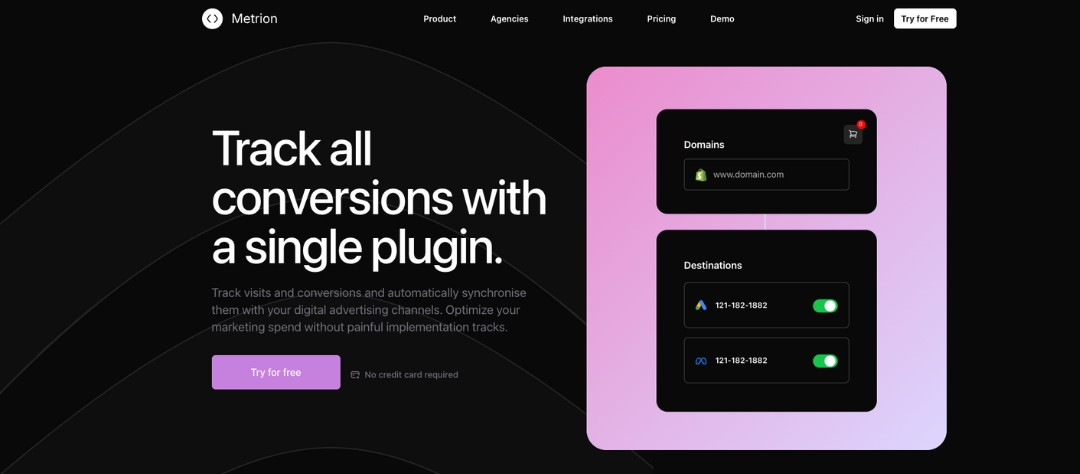
Metrion Adopts Leafcloud as Marketing Analytics Cloud
Marketing agencies face a growing challenge: delivering powerful data analytics while managing their environmental impact.

Make it happen: green cloud solution for Mobiel.nl
Creating clarity in the complex telecom world is what Mobiel.nl has excelled at since day one. Behind the scenes, partner and Tech Lead Martijn van Leeuwen works daily with his team on improving customer processes technically.
AWS/Azure/GCP Service Equivalents
Clear Migration Path for Every Service
Most infrastructure services have straightforward OpenStack equivalents. We've categorized them by migration complexity to show how achievable your migration is:
None (Direct Equivalents) - API-compatible services requiring only configuration updates, no code changes.
Low (Open-Source Standards) - Industry-standard tools with clear migration paths and strong community support.
Moderate (Flexible Alternatives) - Multiple open-source options to escape vendor lock-in, typically requiring containerization.
Containerization Advantage
Cloud-Native Workloads Migrate Faster
If your workloads run on Kubernetes, migration complexity drops dramatically. Containerized applications are inherently portable, making the move to Leafcloud's OpenStack infrastructure straightforward.
Kubernetes to Kubernetes
EKS → Gardener is a configuration change, not a rewrite. Your manifests, Helm charts, and operators work identically.
ML/AI Workloads
Containerized SageMaker workloads migrate to Kubeflow seamlessly. Deploy on RTX 6000 Blackwell (96GB), H100, A100, or A30 GPUs with Gardener Kubernetes. Same acceleration, open-source platform.
API Gateways & Workflows
Kong, Traefik, and Argo Workflows are Kubernetes-native. If you're using these, migration is straightforward.
Not Containerized Yet?
Consider containerizing before migration. You'll gain portability, modern orchestration, and faster timelines. Reach out to discuss your containerization strategy.
Technical Migration Resources
Compatibility, Documentation & Technical Guides
Leafcloud uses industry-standard x86-64 AMD EPYC processors running OpenStack. Any workload that runs on AWS, Azure, or GCP runs on Leafcloud without modification. Access comprehensive migration documentation, guides, and technical resources for planning and executing your migration.
Supported Operating Systems
Ubuntu, Debian, CentOS, Rocky Linux, AlmaLinux, Windows Server 2016-2022. Custom kernels and drivers work identically.
Image Import Methods
OpenStack native import tools, export/import via CLI or Horizon dashboard, live migration with rsync for minimal downtime.
Network Translation
VPC-style networking maps directly to OpenStack Neutron. Private networks, security groups, and floating IPs configured identically.
Storage Compatibility
Provision identical storage layouts. NVMe SSD local volumes or Cinder network block storage equivalent to EBS/Azure Disk.
OpenStack Architecture Guide
Deep dive into OpenStack services and how they map to AWS/Azure/GCP equivalents.
Terraform OpenStack Provider
Documentation and examples for converting your IaC from AWS/Azure providers to OpenStack.
Migration FAQ
Answers to common migration questions about VMs, networking, storage, and Kubernetes.
API Documentation
OpenStack API reference, CLI guides, and SDK documentation for automation.
Frequently Asked Questions
Are containerized workloads easier to migrate to OpenStack?
Yes. Containerized applications on Kubernetes are inherently portable, making cloud migrations dramatically faster. If your workloads run on EKS, AKS, or GKE, migrating to Leafcloud's OpenStack infrastructure is primarily a configuration change, not a code rewrite.
Why containerization accelerates migration:
Kubernetes provides a consistent abstraction layer across all cloud providers. Your application manifests, Helm charts, and Kubernetes operators work identically whether running on AWS EKS, Azure AKS, Google GKE, or Leafcloud's Gardener managed Kubernetes.
Migration timeline for containerized workloads:
- Kubernetes to Kubernetes: 1-4 weeks for most applications (EKS → Gardener)
- Container images: No changes required—pull from same registries (Docker Hub, ECR, GCR, private registries)
- Persistent storage: Kubernetes CSI drivers handle Cinder block storage transparently
- Load balancing: Service type LoadBalancer provisions Octavia load balancers automatically
- GPU workloads: NVIDIA GPUs (H100, A100, A30, RTX 6000) available as Kubernetes node resources
What stays the same:
- Application code: Zero changes to containerized applications
- Deployment manifests: kubectl apply, Helm charts, and Kustomize work identically
- CI/CD pipelines: Update kubeconfig context—workflows remain unchanged
- Monitoring: Prometheus, Grafana, and cloud-native observability tools work identically
- Service mesh: Istio, Linkerd, and Cilium function the same on OpenStack infrastructure
Examples of fast migrations:
- ML/AI workloads: Containerized models on EKS migrate to Gardener with GPU support (H100, A100) in 2-4 weeks
- Microservices: API services with stateless containers migrate in 1-2 weeks
- Data pipelines: Argo Workflows, Apache Airflow, and Spark on Kubernetes move without refactoring
When migration takes longer:
Even with containerization, some dependencies may extend timelines:
- Managed services: Using AWS-specific services (RDS, ElastiCache, SQS) alongside Kubernetes requires replacing with self-managed or open-source alternatives
- Persistent data: Large databases or stateful workloads need careful migration planning for data transfer
- Custom integrations: Applications tightly coupled to hyperscaler APIs need refactoring
Not containerized yet?
If your workloads run directly on EC2, Azure VMs, or GCP Compute Engine, consider containerizing before migrating. You'll gain:
- Faster migration: Kubernetes-to-Kubernetes is weeks instead of months
- Future portability: Move between any OpenStack provider or back to hyperscalers without lock-in
- Modern orchestration: Auto-scaling, rolling updates, and declarative infrastructure
- Cost efficiency: Better resource utilization with container density
Leafcloud provides Gardener managed Kubernetes with full GPU support, integrated with OpenStack infrastructure (Nova VMs, Cinder storage, Neutron networking, Octavia load balancers). Your containerized workloads migrate quickly while gaining EU sovereignty and eliminating egress fees.
Can I migrate existing GPU workloads from AWS, Azure, or GCP to Leafcloud?
Yes. Leafcloud uses standard OpenStack APIs and supports common orchestration tools like Kubernetes, and IaC solutions like Terraform and Ansible making migration straightforward.
Can I migrate workloads from AWS to Leafcloud?
Yes. Leafcloud, which runs on OpenStack, provides similar IaaS capabilities to AWS, and many workloads can migrate with reasonable effort. The complexity depends on your AWS service usage.
Easy to migrate (OpenStack equivalents):
- EC2 → Nova: Virtual machines with similar instance types and APIs
- EBS → Cinder: Block storage volumes with snapshots
- VPC/Security Groups → Neutron: Software-defined networking with security groups
- S3 → Swift: Object storage with S3-compatible API
- ELB/ALB → Octavia: Load balancing with similar capabilities
- Route53 → Designate: DNS management
- EKS → Gardener/Magnum: Managed Kubernetes on OpenStack
Moderate effort (requires refactoring):
- Lambda → Kubernetes Jobs: Replace serverless functions with containerized jobs
- RDS → Self-managed databases: Deploy PostgreSQL/MySQL/MongoDB on Nova instances or managed DBaaS
- SQS/SNS → RabbitMQ/Kafka: Message queuing with open-source alternatives
- CloudWatch → Prometheus/Grafana: Monitoring with open-source observability stack
Open-source alternatives (escape vendor lock-in):
- SageMaker → Kubeflow: 2-4 weeks for containerized ML workloads on GPU infrastructure (H100, A100, A30)
- DynamoDB → Cassandra/MongoDB: 2-6 weeks depending on data model complexity
- API Gateway → Kong/Traefik: 1-2 weeks with Kubernetes-native ingress controllers
- Step Functions → Argo Workflows: 1-3 weeks depending on workflow complexity
Migration strategy:
- Audit AWS usage: Identify which services you actually use (EC2, S3, RDS vs. proprietary services)
- Lift-and-shift compatible workloads: Start with EC2 instances that can move directly to Nova
- Refactor database tier: Migrate RDS to self-managed or OpenStack DBaaS offerings
- Replace proprietary services: Containerize Lambda functions, migrate to open-source alternatives
- Update Infrastructure-as-Code: Convert AWS Terraform/CloudFormation to OpenStack Terraform provider
- Test thoroughly: Run parallel environments during migration window
What makes migration easier:
- Containerized workloads: Kubernetes-based apps migrate seamlessly (EKS → Gardener)
- Standard APIs: Apps using PostgreSQL, Redis, Kafka, S3-compatible storage have direct equivalents
- Minimal managed services: Less dependency on AWS Lambda, SageMaker, DynamoDB means easier migration
OpenStack benefits after migration:
- No egress fees (save $0.12/GB on outbound traffic)
- Transparent pricing (no surprise charges)
- EU sovereignty (Leafcloud in Amsterdam, not subject to US CLOUD Act)
- Vendor independence (switch providers without lock-in)
Leafcloud provides OpenStack infrastructure with GPU support (H100, A100, A30, RTX 6000 Blackwell), managed Kubernetes (Gardener), and S3-compatible object storage to support AWS workload migrations.
Can I migrate VMs from AWS, Azure, or GCP to Leafcloud?
Yes, migrating from hyperscaler VMs to Leafcloud is straightforward thanks to OpenStack's standard APIs and broad tooling support. Most migrations can be completed with minimal downtime using standard Linux tools or OpenStack utilities.
Migration Methods:
For cloud-to-cloud migrations, you have several options:
- Image import: OpenStack provides native import tools that work with common VM formats (QCOW2, RAW, VMDK)
- Export and import: Export your existing VM image from AWS EC2, Azure VMs, or GCP Compute Engine, then import it directly to Leafcloud using the OpenStack CLI or Horizon dashboard
- Live migration: For running workloads, tools like
rsyncor block-level replication minimize downtime during cutover
VM Compatibility:
Leafcloud runs industry-standard x86-64 processors (AMD EPYC 9755 128-Core Processor). Any Linux distribution or Windows Server version that runs on AWS, Azure, or GCP will run on Leafcloud without modification.
Supported operating systems:
- Ubuntu, Debian, CentOS, Rocky Linux, AlmaLinux
- Windows Server 2016-2022
- Custom kernel configurations and drivers work identically
Network & Storage:
Network configurations translate directly:
- Networking: VPC-style networking on AWS/Azure/GCP maps to OpenStack's Neutron networking with private networks, security groups, and floating IPs
- Storage: NVMe SSD local volumes (equivalent to AWS instance storage) or network block storage (equivalent to EBS/Azure Disk)
- Provisioning: You can provision identical storage layouts to your existing infrastructure
No Vendor Lock-In:
Unlike proprietary hyperscaler APIs, OpenStack is open-source with standardized APIs. This means:
- Move workloads freely between any OpenStack cloud or back to AWS/Azure/GCP if needed
- Terraform, Ansible, and other IaC tools work identically across providers using OpenStack's standard APIs
Migration Support:
Our Amsterdam-based team provides migration assistance including:
- Architecture reviews
- Data transfer guidance
- Cutover planning
For complex migrations involving multiple VMs or applications, we offer hands-on support to ensure smooth transitions. Email hello@leaf.cloud or schedule a call to discuss your specific migration needs.
Cost Savings:
Most customers see 20-50% cost reduction after migrating from hyperscalers, particularly for EU workloads. Leafcloud's pricing starts at €0.01/hour (€7.67/month) with:
- No hidden fees
- No data egress charges within EU infrastructure
- No complex pricing tiers
- You pay for compute and storage—that's it
Why use OpenStack instead of AWS, Azure, or Google Cloud?
OpenStack provides open-source cloud infrastructure without vendor lock-in, giving you full control over your infrastructure, APIs, and data. Here's how it compares to hyperscalers:
Vendor Lock-in:
- Hyperscalers: Proprietary APIs (AWS Lambda, Azure Functions, Google Cloud Run) make migration expensive and complex
- OpenStack: Standard APIs supported by multiple providers worldwide - switch providers without refactoring
Cost Structure:
- Hyperscalers: Egress fees (up to $0.12/GB), hidden charges, complex pricing with 200+ SKUs
- OpenStack: No egress fees, transparent pricing, predictable costs
Data Sovereignty:
- Hyperscalers: US-owned companies subject to CLOUD Act, even in EU regions
- OpenStack: Provider-dependent, but enables true EU sovereignty (e.g., Leafcloud in Amsterdam)
API and Tool Compatibility:
- Hyperscalers: Require provider-specific SDKs and services
- OpenStack: Works with standard tooling (Terraform, Ansible, cloud-init, Packer)
Kubernetes Integration:
- Hyperscalers: Managed Kubernetes with proprietary extensions (EKS, AKS, GKE)
- OpenStack: Standards-based Kubernetes (Gardener, Magnum) with full control
When to choose OpenStack:
- Regulatory compliance: NIS2, DORA, CSRD, or HAVEN+ requirements for EU sovereignty
- Cost optimization: High egress traffic or predictable workloads make fixed pricing attractive
- Multi-cloud strategy: Avoid dependency on single vendor's proprietary APIs
- Large-scale deployments: Proven at massive scale (CERN, Bloomberg, Walmart)
- AI/ML workloads: GPU infrastructure without egress fees for model training data
When hyperscalers make sense:
- Extensive use of proprietary managed services (SageMaker, BigQuery, Azure Cognitive Services)
- Small-scale prototyping with free tiers
- Teams deeply invested in hyperscaler-specific tooling
Leafcloud provides OpenStack-based infrastructure in Amsterdam with EU sovereignty, no egress fees, and full compatibility with standard cloud tooling.
Start Your Leafcloud Journey Today
Join organizations that have migrated from hyperscalers to gain cost savings, EU sovereignty, and infrastructure freedom. Our Amsterdam-based team is ready to help.